Last checked: 16 November 2026 · General information only, not financial advice
If you miss a buy now pay later payment, you'll usually be charged a late fee and blocked from making any new purchases until you catch up.
It can only become a default on your credit report once it's 60 or more days overdue and $150 or more, and you've received two separate written notices.
Since June 2025, you've had a legal right to request hardship help for a payment you're struggling to make.
It's easy to say yes to buy now pay later, especially with Black Friday and Christmas around the corner. Four small payments feel manageable, but five separate plans with different due dates, all landing in the same fortnight as rent and the phone bill, are a completely different story.
When people call us about their debts, the juggling is often as difficult as the amount they owe.
Here's what happens when a buy now pay later payment is missed, how it affects your credit score, and what rights you have.
Fees and timing vary by provider. Some steps are set by law, and they apply to all providers.
| When | What can happen | Who sets the rule |
|---|---|---|
| Payment day passes | A late fee. For an Afterpay Pay in 4 order over $40, it's $10, and then another $7 if it's still unpaid 7 days later. Zip Pay charges $7.50 7 days after the due date if you miss the minimum repayment. | Provider terms |
| From the missed payment | You may be blocked from making any new purchases until you pay what's overdue. Afterpay's terms say it can set your spending limit to zero. | Provider terms |
| Within 14 days of your first missed payment | On a low-cost BNPL plan, you can receive a one-off notice about the missed payment, details on how to pay, the provider's hardship process, and how to make a complaint. | National Credit Code s 87 |
| 60+ days overdue, $150 or more | A default on your credit report. The provider must first send a written overdue notice, then a separate notice of intention to list a default at least 30 days later. It then waits at least 14 days. | Privacy Act 1988 (Cth) ss 6Q, 21D; Privacy (Credit Reporting) Code 2025 Sch 2 s 9 |
| Later | A collection agency pursues the debt. Before any court action, the provider generally has to give you a default notice with at least 30 days to catch up on what you owe. | Provider terms; National Credit Code s 88 |
Fees from Afterpay's Pay in 4 Product Terms (last updated 30 June 2026) and Zip's Zip Pay page, both read 16 November 2026. Afterpay caps late fees on an order over $40 at $68 or 25% of the order value, whichever is lower.
That gap before a default is your window to take action.
It can, at three distinct points.
When you apply. Under the lighter lending rules that low-cost BNPL providers can choose, a provider must attempt to get information from your credit report before approving you or raising your limit. It must also ask about your income, spending, and any other BNPL plans, payday loans, and/or leases. Afterpay's credit reporting policy states that its check may affect the score Experian calculates for you.
When you pay. Some lenders report whether each month's repayments were made on time. Only licensed lenders can report this repayment history, and it remains on your file for two years. Paying a BNPL plan on time will only help your credit report if your provider reports it, so check its credit reporting policy beforehand.
When you fall behind. A default usually stays on your credit report for five years. Paying it off doesn't remove it, but it will show as having been paid.
There is some good news here. A lender generally can't list a default while it's deciding your hardship request, or until 14 days after it turns it down. Whether a hardship arrangement itself shows up on your credit report depends on what your provider reports, so be sure to ask them.
If one does show, MoneySmart says it doesn't affect your credit score, you're shown as being up to date as long as you stick to it, and the listing is deleted after 12 months pass.
You can get your credit report for free from each credit reporting body every three months, including Equifax and Experian.
Since 10 June 2025, buy now pay later plans have come under the National Credit Code.
The change came from the Treasury Laws Amendment (Responsible Buy Now Pay Later and Other Measures) Act 2024 (Cth).
If you've read somewhere that BNPL isn't covered by credit law, that information is now out of date.
| What the law now requires | What it means for you |
|---|---|
| An Australian credit licence (ASIC) | Providers answer to ASIC like any other lender. |
| Checks before approving you or raising your limit | You shouldn't be given a plan that's unsuitable for you. |
| The hardship rules in National Credit Code s 72 | You can ask to change your repayments, and they must respond. |
| Membership of the Australian Financial Complaints Authority (AFCA) | You can take a complaint to a free, independent service. |
| A one-off notice after your first missed payment | You hear about hardship help and AFCA early on. |
| Fee caps for "low-cost" plans | In order for a plan to count as low-cost, fees across all your plans with one provider are capped. If late fees are its only fees, they can't go over $320 in your first 12 months, and $245 in each year after. If it charges other fees, late fees are capped at $120 a year. |
Yes. Section 72 of the National Credit Code lets you inform your provider, either by phone or in writing, that you are unable to, or soon won't be able to, keep up with payments.
The provider can ask for more information within 21 days. It generally has to decide within 21 days of your request, or 21 days after you send what it asked for.
If it says no, it must tell you why and give you AFCA's details.
Search for "hardship" on your provider's website or app. Afterpay's hardship page points you to a secure form or "Help" in the app. Its options include changing your payment schedule, waiving late fees, and setting up a payment plan.

It doesn't need to be a long story. Something like this is enough:
"Hi, I'm contacting you about my account. I'm having trouble keeping up with my repayments because [my hours were cut/I've been unwell/my rent went up]. I'd like to apply for financial hardship assistance. I can afford $[amount] a [fortnight/month]. Can you please record this as a hardship request, tell me what information you need, and confirm your decision in writing?"
Keep a note of the date and who you spoke to. If the answer is no or you don't hear anything, you can make a complaint to AFCA by calling 1800 931 678.
Plans may be small, but they stack up.
This illustrative example assumes four equal fortnightly payments per plan.
| Plan | Purchase | Each fortnight |
|---|---|---|
| Headphones | $240 | $60 |
| Kids' shoes and uniforms | $320 | $80 |
| Car service | $400 | $100 |
| Gifts | $160 | $40 |
| Total | $1,120 | $280 |
That's an extra $280 every payday on top of rent, bills and food. If you miss one payment, a late fee lands on that plan. If you use a new plan to cover an old one, the total grows instead of shrinking.
You're not the only one feeling the strain.
In the ABS General Social Survey 2025, a quarter of households (25.3%) had at least one cash flow problem in the past year, such as not being able to pay a utility bill on time. That's up from 20.7% in 2020, although the ABS notes that the 2020 survey ran during COVID-19.
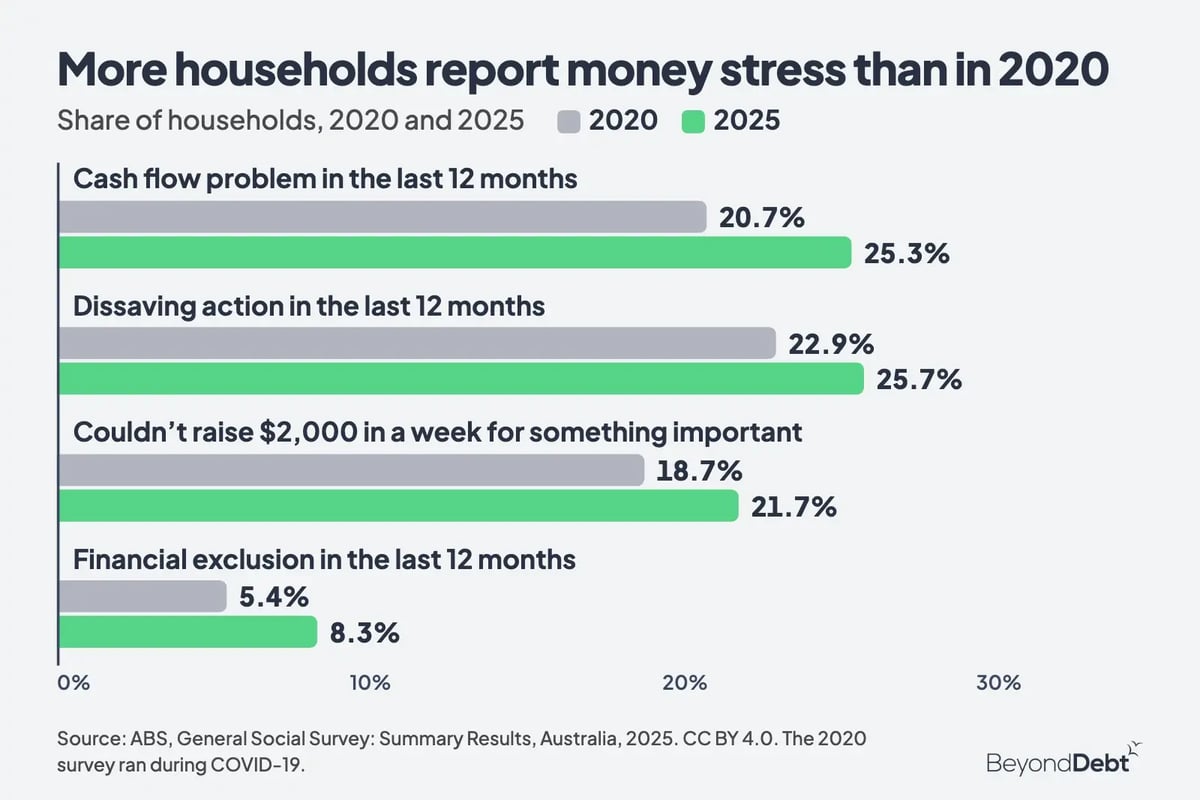
Source: Australian Bureau of Statistics, General Social Survey 2025 (CC BY 4.0). The 2020 figures were collected during COVID-19.
If you're planning to shop the sales anyway, add up what's already due first. Our Christmas budget guide and debt payment strategies can help.
Yes.
Afterpay's customer terms, for example, let it appoint collection agencies to recover what you owe. Collectors have strict rules about when and how they can contact you, and you can see what debt collectors can and can't do in this article.
Asking for hardship help early on gives you the most room before it gets to that point.
Yes.
BNPL debts are usually unsecured, like credit cards and personal loans, and are treated the same way in the formal options. You can't keep one plan separate: the Australian Financial Security Authority (AFSA) says you must list all of your debts in a debt agreement proposal.
If BNPL is one of several debts you're unable to pay, these are the main options, and each has consequences:
AFSA's comparison of the formal options sets out all the details of these options side by side.
We're a registered debt agreement administrator, not a lender, and nothing we offer is a loan.
We provide a free assessment where we look at all your debts together and explain every option, including ones that don't involve us.
The assessment is free, but if you move ahead with a formal option, fees do apply.
For the bigger picture, read our step-by-step guide to getting out of debt.
No. Afterpay's Pay in 4 terms say no interest is payable. Late fees apply if you miss a payment, capped at $68 or 25% of the order value (whichever is lower) for orders over $40.
Only if the provider reports your repayment history to a credit reporting body, so be sure to check its credit reporting policy. Missed payments can still affect your score.
Expect late fees, a blocked account, and possibly a collection agency pursuing your debt. If the debt is $150 or more and 60 or more days overdue, a default can be listed once the required notices are sent, and it stays on your credit report for five years.
It depends on whether your provider reports repayment history, so ask it. If a hardship arrangement does show, MoneySmart says it doesn't affect your credit score, you're shown as up to date while you stick to it, and it's removed after 12 months. A lender generally can't list a default while it's deciding your hardship request.
No. AFSA says you must list all of your debts in a debt agreement proposal, and that includes BNPL plans.
The National Debt Helpline (1800 007 007) offers free financial counselling. If a provider won't help, AFCA can look at your complaint for free.
If BNPL is one of several debts you're struggling with, you don't have to deal with it alone.
Call 1300 870 306 or request a free assessment, and we'll listen, look at your whole situation, and explain every option without any judgement or obligation.
This information is general in nature and does not constitute financial advice. Beyond Debt recommends you seek independent financial advice before making decisions about your debt.
Beyond Debt is a trading name of DCS Group Aust Pty Ltd, Registered Debt Agreement Administrator 1126, Australian Credit Licence 382607.